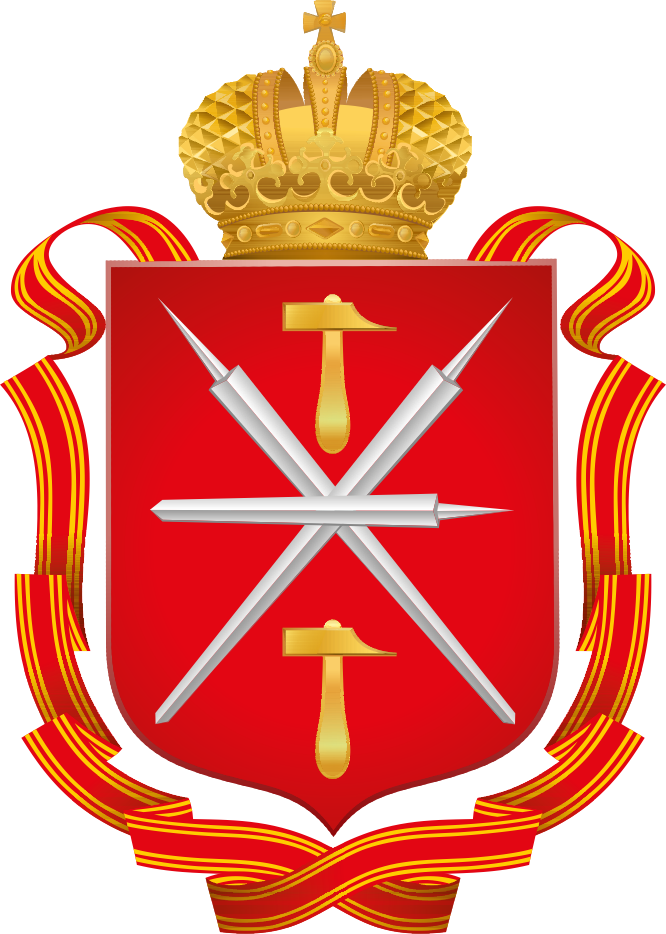
Regional flags and emblems

PROFILE
Established 26 September 1937
Capital Tula
The Tula Region is part of the Central Federal District
Area 25,700 sq km
Population 1 456 800 (2026)
Ethnic groups
(2020 National Census, %)
Russian – 94,10
Other – 5,90
Administrative divisions (2026)
Municipal districts – 14
Municipal areas – 6
City districts – 6
Rural towns – 18
Rural districts – 42
Geography and climate
The Tula Region is in the East European Plain and borders on the Orlov, Kaluga, Moscow, Ryazan and Lipetsk regions.
The region has a moderate continental climate with warm summers and an average July temperature of +21,9°C, and moderately cold winters. The average January temperature is –10.2°C.
According to the Forest Fund, forests cover about 11% of the region’s total area. It has 1,682 rivers, 652 ponds and five large water reservoirs. The main rivers are Oka, Upa and Osyotr. There are lakes in the valleys of the Oka and Upa rivers. The largest of them are Shilovskoye and Zhupel. There are also karst water lakes. The region has many sources of fresh underground and mineral medicinal waters.
The Tula Region has 54 specially protected areas, including the national park ”Tulskiye Zaseki“, the Polenov State Memorial Historical, Art Museum and Nature Reserve, the Yasnaya Polyana Leo Tolstoy Estate Museum, the Kulikovo Field State Military-Historical and Natural Reserve, and numerous nature landmarks.
Government
The Legislative branch in the Tula Region is represented by the Tula Regional Duma, which is the permanent, representative and only body of state legislative authority in the region. The Tula Regional Duma consists of 36 deputies, 24 of which are elected in single member constituencies and 12 in single electoral districts in proportion to the number of votes cast for the candidates nominated by the political parties. The current Regional Duma was elected in September 2024 for a term of 5 years.
The executive branch in the Tula Region is represented by the Governor of the Tula Region, the Government of the region and other executive agencies in the region. The Government of the Tula Region is the supreme and permanent body of executive authority in the region, which is formed by the Governor of the Tula Region. The Chairman of the Government of the Tula Region is appointed and dismissed by the Governor of the Tula Region.
The Governor of the Tula Region is the region’s highest-ranking official who heads the executive branch in the Tula Region and determines the structure of executive bodies in the Tula Region. The Governor is elected for five years by Russian citizens who permanently reside in the region. The incumbent Governor’s term of office expires in September 2029.
Economy and natural resources
The Tula Region possesses significant industrial potential. The main branches of industry in the Tula Region are mechanical engineering and metalworking (including the largest enterprises in the field of Russia's military‑industrial complex), the chemical industry, ferrous metallurgy, the production of building materials, and light and food industries. These branches hold the largest share in the structure of the gross regional product.
The largest enterprises are JSC ”Instrument‑Making Design Bureau named after Academician A.G. Shipunov“, PJSC ”Tula Arms Plant“, JSC ”AK Tulamashzavod“, JSC ”Tula Cartridge Plant“, JSC ”Khimvolokno“, PJSC ”Tulachermet“, PJSC ”Kosogorsky Metallurgical Plant“, JSC ”Tula Brick Plant“, LLC ”Shchekinoazot“, and others.
The main mineral resource is brown coal. The Tula strontium‑bearing province is also located on the territory of the region, to which celestine ores (strontium) are confined. Agronomic ores – phosphorites and glauconite sands – are widespread. Deposits of rock salt, iron ores, and over 160 deposits of building materials have been explored and are being exploited.
The region has favourable soil‑and‑climatic conditions for agriculture and livestock farming. One of the priority directions for the development of the economy of the Tula Region is the development of the agro‑industrial complex, which is primarily oriented towards the production of grain, sugar beet, potatoes, vegetables, oilseeds, fruit and berries; in livestock farming – the production of meat, milk and eggs.
The region’s economy is distinguished by a trend towards higher investment activities. Processing industries prevail in the structure of investment in the capital stock. This applies to chemical and metallurgical production and metal goods manufacture.
Culture and tourism
The Tula Kremlin is one of the most important historical landmarks of Tula. It is a rectangle with 9 towers surrounded by a 10 m high wall. Archaeologists believe that the construction of this Kremlin involved Italian architects.
Tula has been a city of armorers since times immemorial and naturally has a museum of arms – the Tula State Museum of Weapons. It was established in 1775 when Catherine the Great ordered the construction of a chamber of rare and model arms at the Tula Arms Plant. For a long time models of the art of gunnery from Peter the Great times to our days were displayed in the Epiphany Cathedral of the Tula Kremlin. In 2012, the museum moved to a new building with a cupola shaped as a helmet of a Russian warrior. The museum’s buildings occupy more than 14,000 sq m. The territory has a site for the open display of bulky combat hardware.
Samovar (literally self-boiler) is another symbol of Tula. The Tula Samovar Museum was opened in 1990. It's about the emergence and development of the samovar-making craft and are shown its best models.
There is yet another symbol of Tula – the Tula pryanik (honey cake). One of the museums in the region’s administrative center is devoted to this treat.
Polenovo is a picturesque open-air museum of artist Vassily Polenov, where are located house-museum, workshop and the Trinity Church. The size of the memorial fund is huge: painting, graphics, personal effects of the artist.
Yasnaya Polyana is closely linked with the life and work of Leo Tolstoy. He was born and buried here. In this place he wrote many pieces that won him world fame. Yasnaya Polyana is a unique memorial and nature reserve. It has preserved old buildings surrounded by beautiful parks, gardens and forests. Now Tolstoy’s house has been turned into a museum with his personal belongings, different editions of his books and his library.
History lovers are bound to visit the Museum of the Battle of Kulikovo. It is located near the village of Ivanovka in the Kurkinsky District.
Every year, the Guryevskiye quarries attract those who are interested in caving. They consist of three systems of underground passes on the bank of the Osyotr River. Their total length is 100 km.