
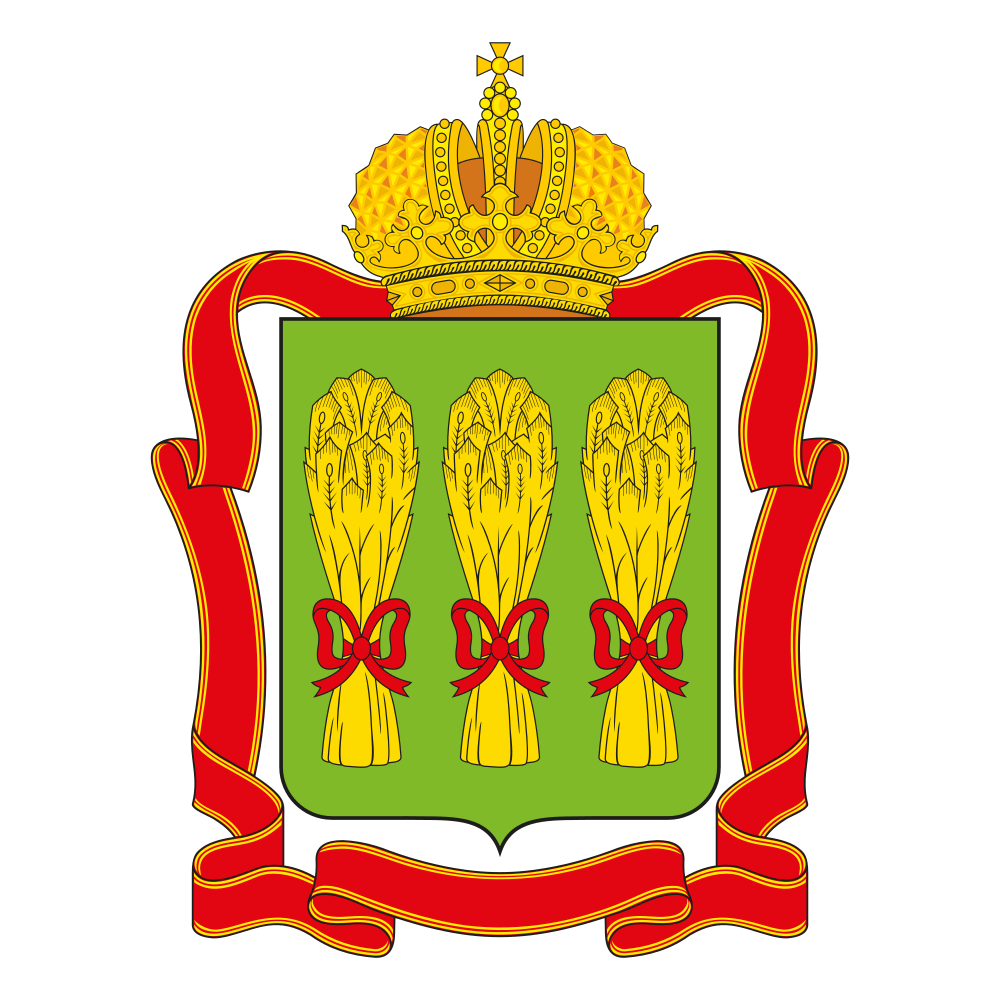
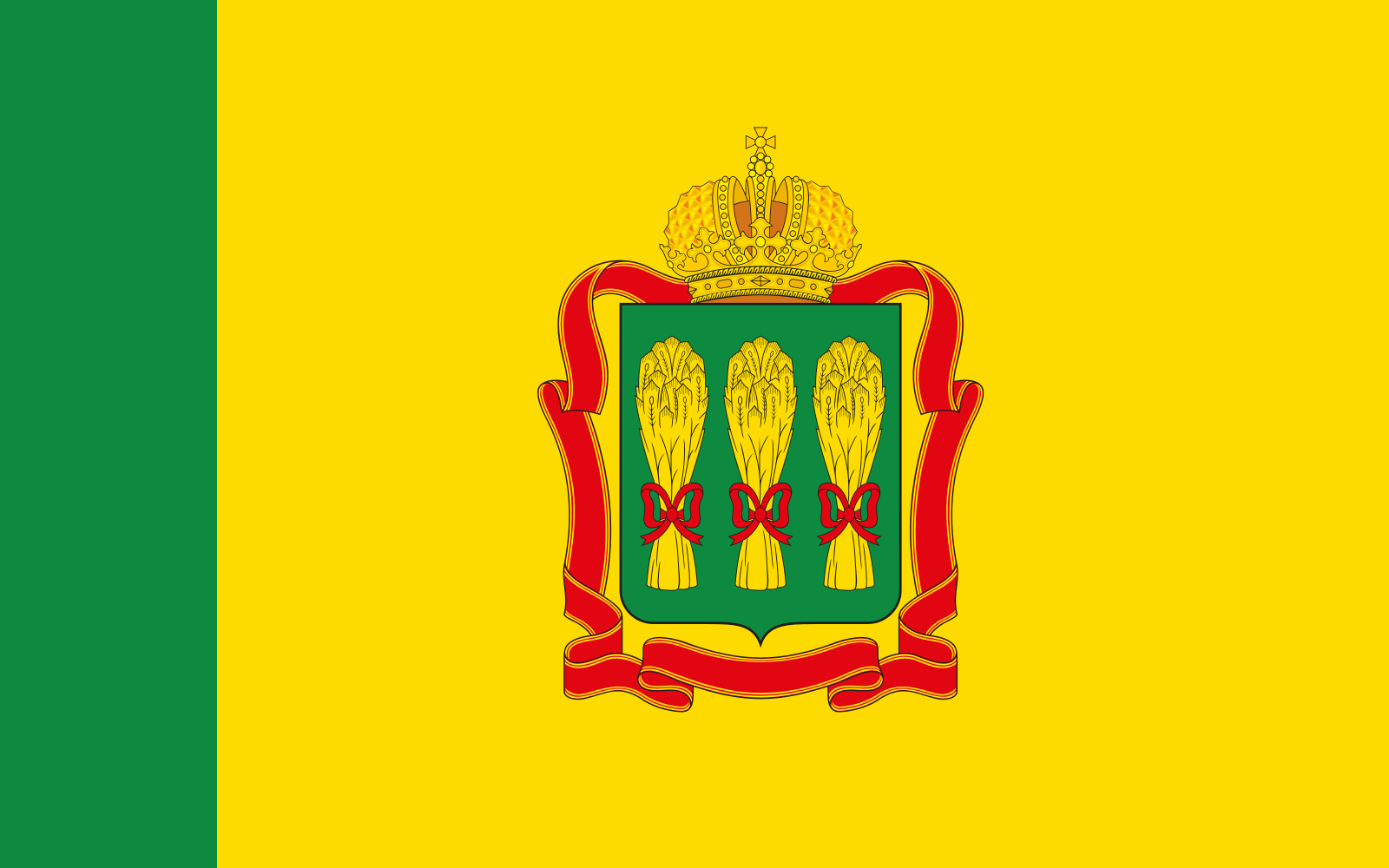
Regional flags and emblems
PROFILE
Established 4 February 1939
Capital Penza
The Penza Region is part of the Volga Federal District
Area 43,400 sq km
Population 1 226 900 (2026)
Ethnic groups
(2020 National Census, %)
Russian – 87,57
Tatar – 6,44
Mordva – 2,46
Other – 3,53
Administrative divisions (2026)
Municipal districts – 27
City districts – 3
Rural towns – 24
Rural districts – 264
Geography and climate
The region is located on the western slopes of the Volga Uplands (alt. up to 331 m) in the Middle Volga area; the westernmost part is located in the Oka-Don Lowlands (150–180 m).
The Penza Region stretches 330 km from east to west and 204 km from north to south at its widest points.
It borders on the Republic of Mordovia and the Ulyanovsk, Saratov, Tambov and Ryazan regions.
There are about 330 rivers and several lakes on the floodplains. The area of the Sura Reservoir is 110 sq km and its water volume is 560 mln cu m. The main rivers are the Sura (335 km), the Khopyor (191 km) and the Moksha.
The climate is temperate continental with January
temperatures averaging
–11.6°C and July temperatures averaging +21.8°C. Average precipitation
in January is 34 mm; average precipitation in July is 73 mm.
The frost free period is from 125 days in the north to 139
days in the south.
Vegetation: deciduous and pine forests (oak, ash, linden, maple, mountain elm, birch, aspen, rowan tree, bird cherry and willow) turning into meadow steppe.
Soils: bleached degraded black soils, pale-grey and grey wood soils, meadow-black soils and alluvial soils.
Privolzhsky Les Nature Reserve is located on the watershed between the Volga and the Don. It was established in 1924 to protect northern steppes and timberland. The area of the reserve is 8,373 ha. The land around it is a buffer zone where economic activity is restricted.
Government
The legislative branch is represented by the Legislative Assembly of the Penza Region, which is the permanent, representative and only body of legislative authority in the region.
The Legislative Assembly of the Penza Region has 36 deputies elected for five years, with 18 of them running in single-mandate constituencies and the other 18 in the region-wide electoral district, where winners are identified in proportion to the number of votes cast for lists of deputies nominated by electoral associations.
The current Legislative Assembly was elected in September 2022 for a term of 5 years.
The executive branch of the Penza Region is represented by the Governor of the Penza Region, the Government and other executive agencies of the Penza Region.
The Governor of the Penza Region is the region’s highest-ranking official who heads the executive branch and determines the structure of the executive bodies of the Penza Region. The Governor is elected by citizens of the Russian Federation residing in the region for a term of five years. The expiration date for the current Governor is September 2026.
The Government of the Penza Region is the supreme and permanent executive body in the region that heads other executive agencies of the Penza Region. The Prime Minister of the Penza Region heads the Government of the region and organizes its activities.
Economy and natural resources
Industrial production is the leading type of economic activity in the Penza Region. The region’s industrial complex comprises about 2.5 thousand industrial enterprises, employing more than 78 thousand people. Industry accounts for one quarter of the gross regional product.
Historically, the Penza Region’s specialization has been manufacturing a wide range of machinery and equipment for the power industry, transport, and the oil and gas industry.
Currently, there is brisk growth in machine and tool manufacturing, food products, and timber and pulp production.
Penza Region is a centre of Russian machine‑tool building: every fourth metal‑working machine tool in Russia is produced by enterprises of the ”PenzaStankoMash“ cluster, and it occupies leading positions in the Volga Federal District in the production of cabinet furniture. Approximately 70% of artificial heart valves implanted in Russia and about 17% of surgical suture material used in operations are produced by enterprises of the ”BioMed“ biomedical cluster.
The mechanical‑engineering complex is represented by over 60 large and medium‑sized mechanical‑engineering enterprises. The most important types of mechanical‑engineering products are: chemical equipment and industrial shut‑off valves, diesel engines and diesel generators, compressors, turbochargers and pumps, automotive components, fuel tankers and special‑purpose vehicles, information‑measuring systems, automation and safety equipment for technological processes used in railway transport and nuclear power, agricultural machinery and equipment for farms, and others. The largest enterprises in the sector include: JSC FSPC ”PA Start named after M.V. Protsenko“, JSC ”Penzadieselmash“, JSC ”Radio Plant“, JSC ”NIIFI“, JSC ”SPE Rubin“, JSC ”GRAZ Plant“, JSC ”Serdobsk Machine‑Building Plant“, and others.
Successfully growing industries in the Penza Region include pulp and paper production, wood processing and woodware production. Among the most important items produced are wallpaper, base paper for furnishing print, base paper for making decorative film, base paper for paper laminate, cardboard, school exercise books, corrugated packaging, plywood, furniture, particle board and others.
The food industry makes confections, dairy products, cheese, sausages, semi-finished meat products, poultry, sugar, bread and cereals, soft and alcoholic drinks, beer and other.
The consumer goods industry produces nonwoven fabric, cloths for various industries, clothes for children and adults, knitwear, shoes and safety footwear, leather accessories (bags, suitcases) and more.
The main construction materials produced by the region’s enterprises include cement, sand-lime bricks, porous concrete, steam-cured gas-concrete blocks, reinforced concrete products and structures, dry building mixes, glass and crystalware, and more.
Natural resources in the Penza Region include construction minerals and also small oil reserves in the town of Kuznetsk and the Kameshkirsky District.
Agriculture is based on grain crops and livestock. Most of the Penza Region is tilled soil: 85 percent of the land is arable. The climatic conditions are favourable for growing vegetables, beets, sunflowers, onions and potatoes. The region has potential to expand food production to supply large cities in the Volga and Central Federal districts, but due to inefficient marketing and processing systems, farms in the region are mostly limited to selling to local consumers so far.
Culture and tourism
Penza Region possesses a unique, rich and diverse historical, cultural and natural heritage, as well as a developed cultural infrastructure. The region's heritage includes unique memorial sites associated with historical events and with the lives of outstanding figures of culture, science, art and literature. Among them are the major writers and poets – M.Yu. Lermontov, A.N. Radishchev, V.G. Belinsky, M.E. Saltykov‑Shchedrin, D.V. Davydov, A.I. Kuprin; figures of the arts – V.E. Meyerhold, I.I. Mozzhukhin, K.A. Savitsky; and scholars – V.O. Klyuchevsky, F.I. Buslaev, P.N. Yablochkov, and others.
Penza Regiom is home to museums that are unique of their kind, well known far beyond the country's borders. As early as 1789, the Museum of Crystal and Artistic Glass was established in the town of Nikolsk, housing a unique collection of works of decorative and applied art. The Museum of One Painting and the Museum of the Historian V.O. Klyuchevsky are the only ones of their kind in the world. A gem of Russian national culture is the State Lermontov Museum‑Reserve ”Tarkhany“, which is included in the list of particularly valuable cultural heritage sites of the peoples of Russia. Half of the great poet's life was spent here, and many of Lermontov's creations were born here. His ashes also rest here. Since its opening, the museum has become one of the country's largest research and educational centres for Lermontov studies, attracting over 300,000 tourists annually.
The territory of the Penza Region is home to 370 cultural heritage sites, 47 of which are of federal significance, and the remainder of regional and local significance.
The hospitality industry in Penza Region is fairly well developed. The region has over 120 hotels, more than 30 tourist bases and 10 sanatoriums. The sanatoriums of Penza have their own distinctive feature: the use of medicinal chloride‑sodium slightly alkaline mineral waters for internal consumption and for therapeutic baths.
In recent years, the region has been actively developing event‑based activities, which are attracting increasing interest from tourists: the All‑Russian Lermontov Poetry Festival; the Jazz May jazz festival; the historical festival ”Zolotaryovskoye Settlement – Crossroads of Civilisations“; the only symposium on artistic glass in Europe, held in Nikolsk; the Kuprin Literary Festival; the annual Tikhvin Fair; the All‑Russian Festival of Folk Arts and Crafts ”Penza – Heart of Craftsmanship“; the International Sculpture and Painting Symposium; and others.