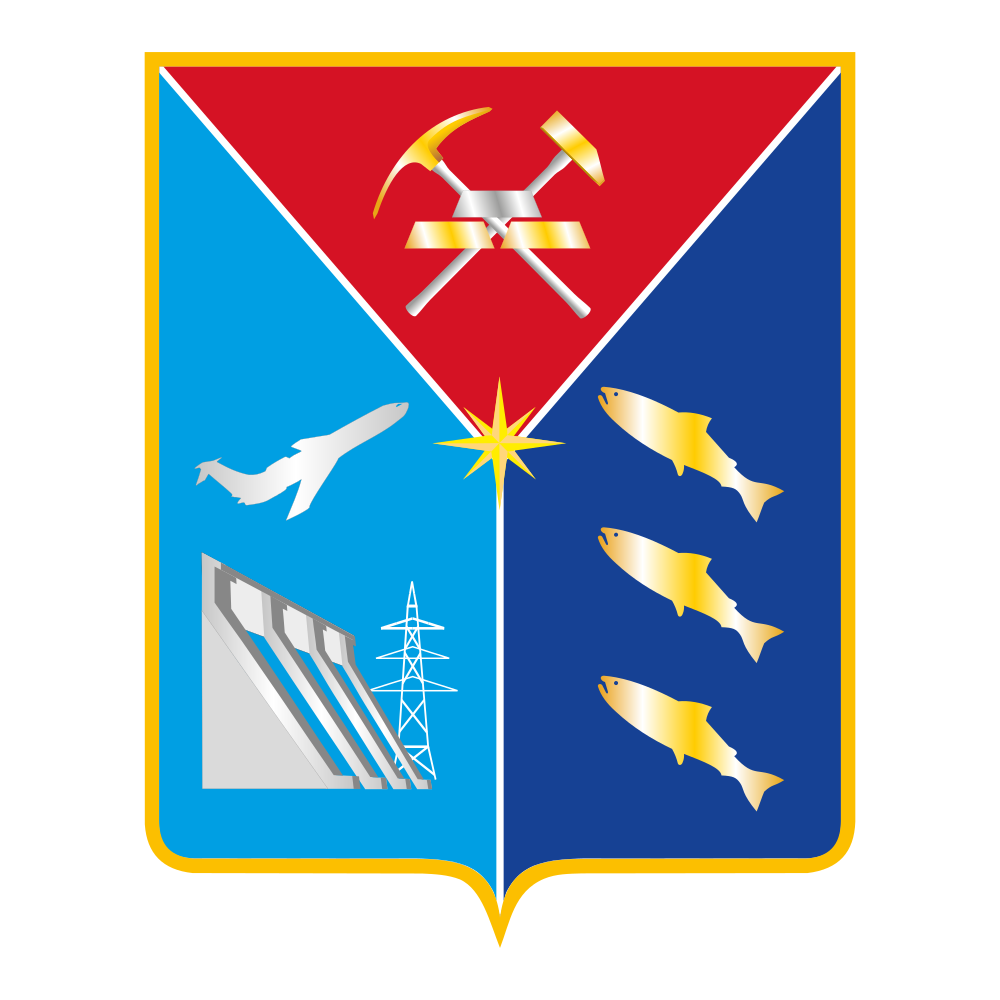
Regional flags and emblems
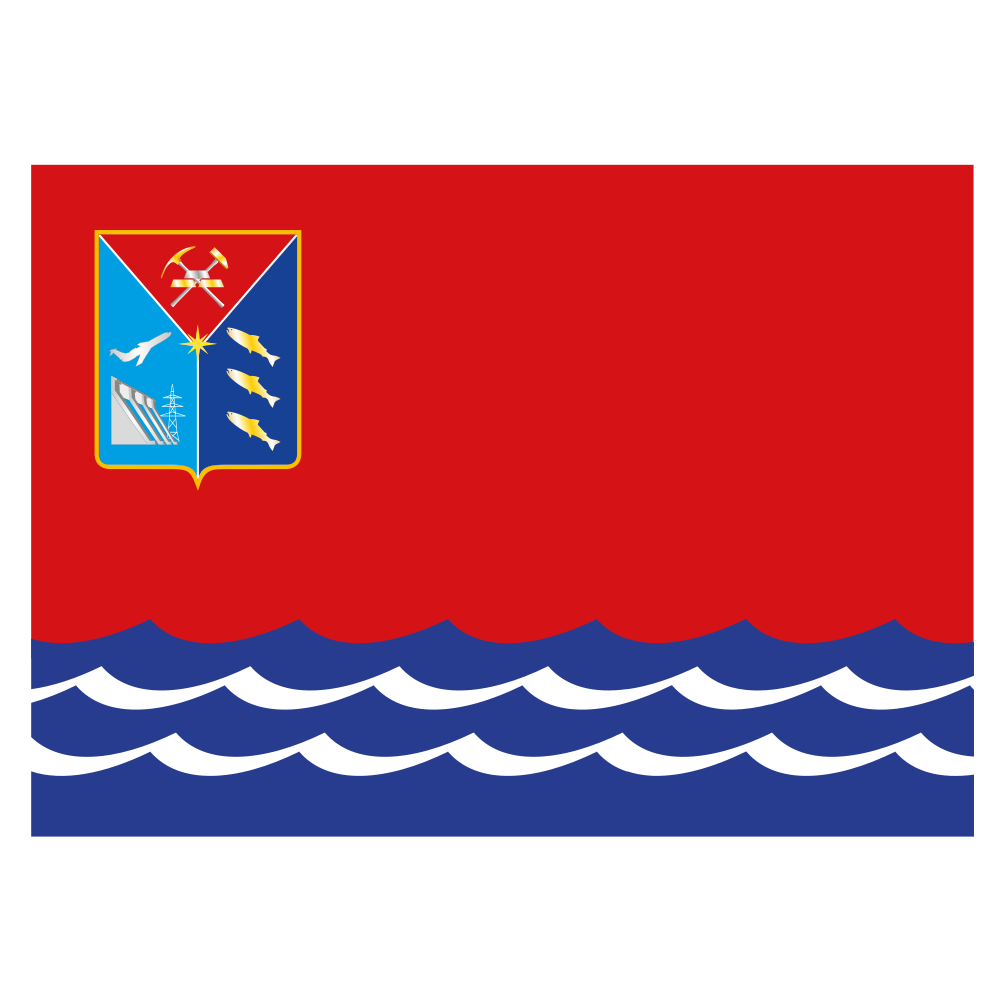
Established 3 December 1953
Capital Magadan
The Magadan Region is part of the Far Eastern Federal District
Area 462,500 sq km
Population 134 500 (2026)
Ethnic groups
(2020 National Census, %)
Russian – 87,71
Ukrainian – 2,70
Even (Lamut) – 1,65
Other – 7,94
Administrative divisions (2026)
Municipal districts – 8
City districts – 1
Geography and climate
The region is located in the northeastern part of Russia and is washed by the Sea of Okhotsk. The area is marked by the Kolyma Highland in the east and the offset of the Chersky Range (up to 2,586 m high) in the center, as well as vast lowlands in the southeast.
The region borders on the Republic of Sakha (Yakutia), the Kamchatka and Khabarovsk territories, and the Chukotka Autonomous Area.
The major rivers include the Kolyma, Omalon and Korkodon. The climate is extremely continental. The average temperature in January is −32.8° C and in July it is +13.5° C. Harsh precipitation in January is 19 mm and in July 125 mm. The area is extensively covered with permafrost. The vegetation period lasts up to 100 days. Three quarters of the territory is tundra and forest tundra.
The region has a state nature reserve, Magadansky.
Government
The legislative branch is represented by the Magadan Regional Duma, which is the permanent, representative and only legislative authority in the region.
The Magadan Regional Duma has 21 deputies elected for a period of five years, with 10 of them running in single-mandate constituents and the other 11 in the single electoral district in proportion to the number of votes cast for lists of deputies nominated by electoral associations.
The current Magadan Regional Duma was elected in September 2025 for a five‑year term.
The executive branch in the Magadan Region is represented by the Governor of the Magadan Region, the Government of the Magadan Region, the supreme and permanent executive body of the region, the financial body of the Magadan Region, and other executive agencies of the Magadan Region.
The Governor of the Magadan Region is the highest-ranking official of the region, who runs the region’s executive branch, determines the structure of the executive bodies of the Magadan Region, forms and heads the Government of the region.
The Governor is elected for five years by Russian citizens who permanently reside in the region. The term of office of the current incumbent expires in September 2028.
Economy and natural resources
The share of industrial production in the regional GDP exceeds more then 50%. Processing facilities include the nonferrous-metals industry, construction materials and food production, including fishing industry.
Mineral extraction is carried out on the basis of proven deposits of gold, silver, ferrous and non‑ferrous metals, brown coals, copper, molybdenum, basalt, limestone, and facing stones. The region ranks first in Russia in terms of proven gold reserves (the largest being the Natalkinskoye deposit). Industrial extraction of placer gold is carried out by LLC ”Susumanzoloto“, the Arbat Concern (LLC ”Kongo“, LLC ”Energia“), LLC ”Status“, LLC ”Polevaya“, and others. The major enterprises extracting ore gold are LLC ”Omolon Gold Mining Company“, JSC ”Silver of Magadan“, JSC ”MRC Pavlik“, JV JSC ”Omsukchanskaya GGK“, and LLC ”Electrum Plus“. Approximately 98% of silver in the region is extracted by JSC ”Silver of Magadan“ and LLC ”Omolon Gold Mining Company“, which are subsidiaries of JSC ”Polymetal“.
The region’s energy grid consists of Magadan Thermal Power Station and Arkagalinskaya Combined Heat and Power Station, as well as of Kolyma Hydroelectric Power Station.
The fisheries complex is significant for the region’s economy. It is represented by companies engaged in industrial and coastal fishing. Each has its own fleet and fish‑processing enterprises. The fisheries sector of the Magadan Region has high social significance, providing employment for the population in coastal settlements and in the city of Magadan. Enterprises and organisations of the sector provide a permanent source of income for up to 10% of the region’s population, including workers and their families. The largest among them are LLC ”Magadanryba“, LLC ”Tikhrybkom“, and LLC ”Mag‑Si International“.
Due to the harsh climate and scarce nature, the region is of little use in terms of agriculture. Development of an agricultural industrial park is one of the region’s development priorities. In some districts, vegetables are cultivated both outside and under glass. The Dukchinskaya poultry farm is the main company supplying the region with fresh eggs and chicken. Reindeer breeding is a traditional activity of the Evens in the Severo-Evensky district.
Culture and tourism
Magadan is the northernmost warm-water port in the Russian Far East. It grew from a village founded during a geological survey expedition.
The region is known for picturesque bays (Nagayev and Gertner) with a beautiful sea view and plenty of fish, as well as the 15-metre-high sculpture, the Mask of Grief, erected in memory of political repression victims on the Krutaya mound, and a memorial to local heroes of the frontline and labour fronts during the Great Patriotic War.
Those interested in stones should visit the Golden Room Museum that has minerals, ores, gold nuggets and placer gold on display. The Museum of Geology and Mineralogy has a copy of Dima the mammoth and the largest collection of meteors. The Magadan Regional Museum of Local History, established in 1934 based on the first local history exhibition, has more than 5,000 items, including paintings, graphics, sculpture, crafts, and a collection of carved and engraved bone artifacts.
There are plenty of wildlife sanctuaries and hunting grounds in the Khasynsky, Srednekansy, Susumansky, Olsky and Severo-Evensky districts that attract hunting and fishing enthusiasts. Rafting on the Kolyma River also offers a good fishing experience.
Talaya Resort in the Khasynsky district is a well-known balneotherapy destination, with mineral waters and mud having medicinal properties that help treating locomotor system, digestive tract, liver and peripheral nervous system disorders, skin and gynecological conditions.