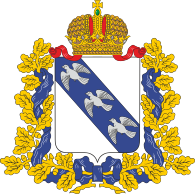
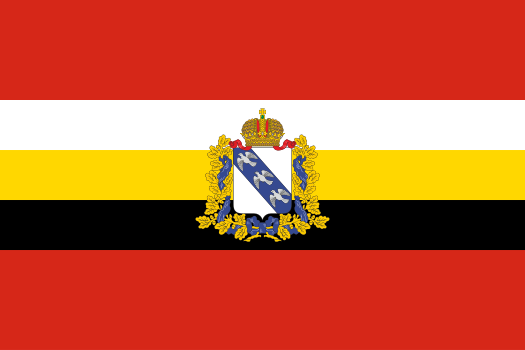
Regional flags and emblems
Established 13 June 1934
Capital Kursk
The Kursk Region is part of the Central Federal District
Area 30,000 sq km
Population 1 049 800 (2026)
Ethnic groups,
(2020 National Census, %)
Russian – 95,93
Other – 4,07
Administrative divisions (2026)
Municipal districts − 28
City districts − 5
Rural towns − 27
Rural districts − 287
Geography and climate
The Kursk Region is located in the central part of the Eastern European Plain. The Region borders on the Bryansk, Orlov, Lipetsk, Voronezh, and Belgorod regions, as well as Ukraine.
The basins of the Dnieper (Seim, Psel) and Don rivers are located on its territory. The main type of soil is chernozem. The climate is temperate continental. January temperatures average –7.6°C, July temperatures average +23.3°C. Average precipitation in January is 50 mm; average precipitation in July is 94 mm.
The Kursk Region is home to 10 specially protected natural areas, including the Central Black Earth State Natural Biosphere Reserve named after Professor V.V. Alekhin, as well as 6 natural monuments and 3 natural parks.
Government
The legislative branch is represented by the Kursk Region Duma, which is the permanent, representative and only body of legislative authority in the region. The Kursk Region Duma has 45 deputies elected for five years, with 22 of them running in the single electoral district, where winners are identified in proportion to the number of votes cast for lists of candidates nominated by electoral associations, and the other 23 in single-mandate constituencies.
The current Kursk Region Duma was elected in September 2021 for a term of 5 years.
The executive branch in the Kursk Region is represented by the Governor of the Kursk Region, the Government of the Kursk Region, which is the supreme body of executive authority in region, and other executive agencies of the Kursk Region. The regional government is the permanent body of executive authority, which coordinates the activities of other executive agencies of the Kursk Region. The government is headed by the First Deputy Governor of the Kursk Region – Prime Minister of the Kursk Region, who is appointed and dismissed by the Governor of Kursk Region.
The Governor of the Kursk Region is the region’s highest-ranking official, who runs the executive branch in the region, determines the structure of the bodies of executive authority of the region and forms the Government of the region. The Governor is elected for five years by Russian citizens who permanently reside in the region. The current Governor's term of office expires in September 2030.
Economy and natural resources
The region is located in the centre of the world's largest iron‑bearing Precambrian megastructure, known as the Kursk Magnetic Anomaly.
Manufacturing in Kursk Region is represented by ferrous metallurgy, mechanical engineering and metalworking, the chemical and petrochemical industries, and the food industry. The region is home to one of the largest ferrous metallurgy enterprises in central Russia – JSC ”Mikhailovsky GOK“.
Iron ores are concentrated in more than 30 deposits, beds and occurrences. The only deposit where iron ores are extracted by open‑cast mining is the Mikhailovskoye iron‑ore deposit.
In addition to iron ore, the region also extracts phosphorites, peat, and building materials: chalk, low‑melting and refractory clays and loams, quartz sands, and mineral waters.
The production and distribution of electricity, gas and water are represented by the branch of the Rosenergoatom Concern ”Kursk Nuclear Power Plant“ and by enterprises of the PJSC ”Kurskenergo“ system.
Agriculture is an important branch of the region’s economy. Agricultural land accounts for more than 75% of the total land area of the region. The main areas of crop farming are the production of cereals and fodder crops, sugar beet, soya, sunflower, potatoes and other vegetables; of livestock farming – dairy and beef cattle breeding, and poultry farming.
In the import structure of Kursk Region enterprises, the largest share falls on machinery and equipment, foodstuffs, chemical industry products, rubber, metal products.
Culture and tourism
The Kursk Region as well as its capital, Kursk, has many monuments commemorating the Battle of Kursk and other battles of the Great Patriotic War. The village of Ponyri has a memorial complex honouring the heroes of the northern face of the Kursk Bulge.
The Kursk Region is rich in history and arts. Rylsk is one of the best-known cities in the region. It was founded in the 10th century on St Ioann of Rylsk Mount as a fortress. The town is noted for having largely preserved its old buildings (XVIII-XIX centuries) and does not have more recent architecture.
The principal church of Rylsk and one of the Kursk Region’s landmarks is the Church of the Intercession. Its form is that of a circle with protruding rectangular sections on three sides.
The Rylsk Regional History Museum has much to tell about the region’s past and natural wonders. The Maryino Estate of the Counts Baryatinsky is noted for its architecture and park, and is the gem of the village of Ivanovskoye in the Rylsk District. The estate was earlier the property of Getman Mazepa, and was taken from him by Tsar Peter the Great following his betrayal and given to the counts.
The village of Zapovedny, which is situated 10 km from Kursk, is home to the Alyokhin Central Chernozem State Biosphere Reserve. It is the world’s only example of a meadow forest steppe area. The reserve covers over 5,000 ha, and has 920 plant species.
The Kursk Region has preserved numerous locations connected with famous people. For instance, tourists can visit poet Afanasy Fet’s estate in the village of Vorobyovka in the Zolotukhino District. There is an old park with a pond, a two-storey mansion, auxiliary buildings that housed servants and the stables. The Village of Mokva is the site of a sanatorium, which stands next to the palace of Count Alexander Nelidov, the 19th-century Kursk Governor General. The palace was built in the early 19th century and is a mix of six different architectural styles.