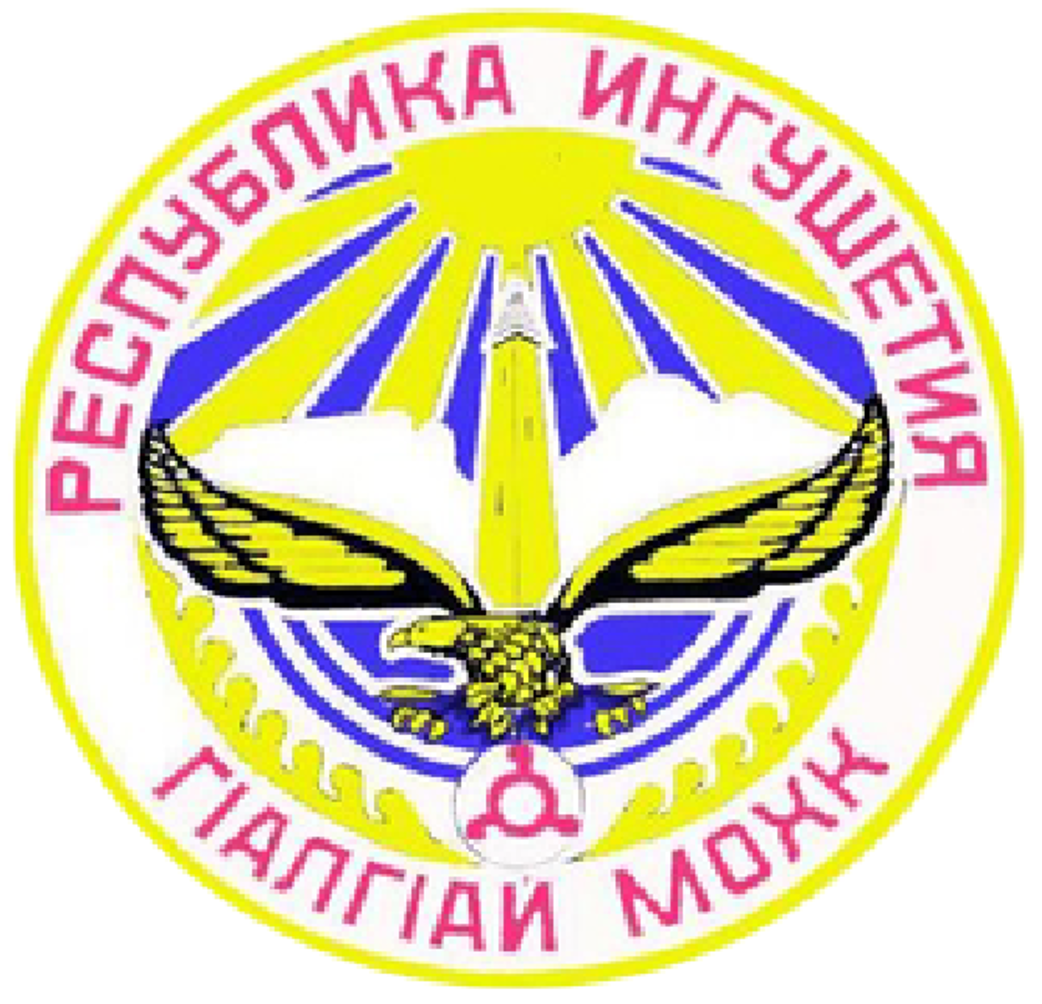
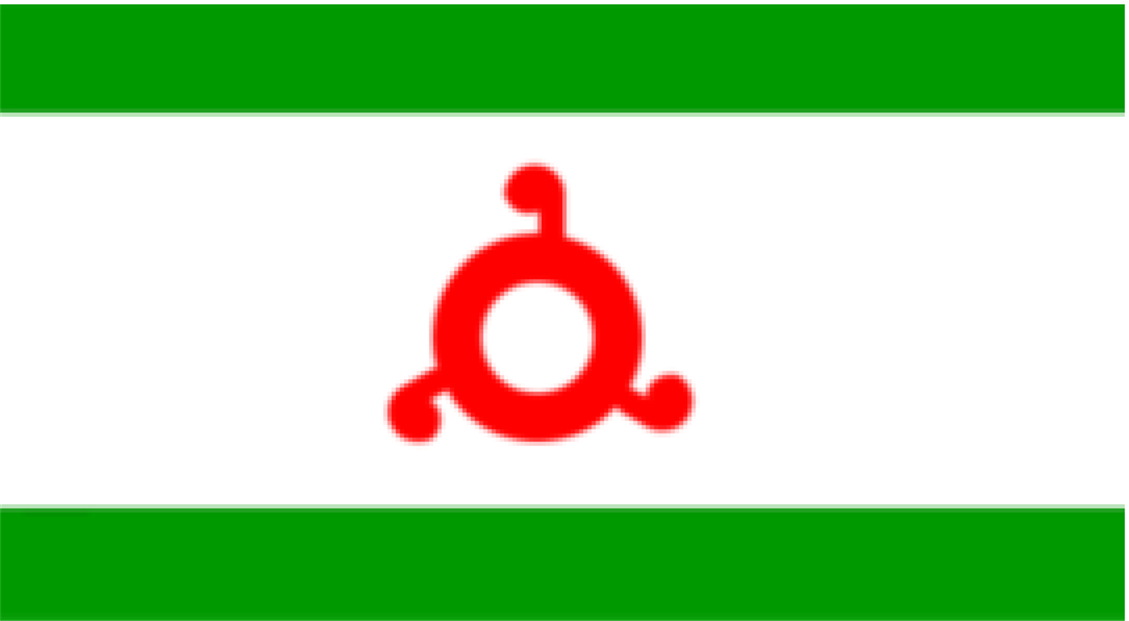
Regional flags and emblems
PROFILE
Established 4 June 1992 as Ingush Republic; the Republic of Ingushetia since 1996
Capital Magas
The Republic of Ingushetia is a part of the North Caucasus Federal District
Area 3,100 sq km
Population 534 500 (2026)
Ethnic groups
(2020 National Census, %)
Ingush – 96,40
Chechen – 2,49
Other – 1,11
Administrative divisions (2026)
Municipal districts – 4
City districts – 5
Rural districts – 36
Geography and climate
The Republic of Ingushetia is located in the central part of the northern slope of the Greater Caucasus and the adjoining Chechen Plain. The mountains of the Greater Caucasus are situated in the south and the Tersky Ridge in the north. They are divided by the Sunzha River, which flows from west to east.
The Republic shares borders with two other regions of the Russian Federation, the Republic of North Ossetia-Alania and the Chechen Republic. The Republic has also a state border with Georgia.
The terrain is at higher altitudes, with mountain ridges divided by valleys and canyons. The Greater Caucasus stretches for almost 150 km in Ingushetia. Some peaks in the southern part of the republic are over 3,000 m above sea level (Shan Mountain is 4,451 m) and the mountain ridges (Black Mountains) have many creeks and canyons.
A distinctive feature of the republic is the variation in climatic indicators caused by the mountainous terrain. The average temperature in January is −0.2°C, and in July – +23.5°C.
The republic has several specially protected areas: the Erzi Nature Reserve, the Ingushsky State Nature Sanctuary..
Government
The legislative branch in the region is exercised by the People's Assembly of the Republic of Ingushetia, which is the permanently functioning representative and the only legislative body of state authority of the republic. It consists of 32 deputies, who are elected by the republican electoral district. Deputy mandates are distributed among lists of candidates for deputies in proportion to the number of votes received by each of the lists of candidates for deputies. The current composition of the People's Assembly of the Republic of Ingushetia was elected in September 2021 for a term of 5 years.
Executive power in the Republic of Ingushetia is exercised by the Head of the Republic of Ingushetia, the Government of the Republic of Ingushetia and other executive bodies of state power of the republic.
The Head of the Republic of Ingushetia is the republic’s highest-ranking official, who determines the structure of the executive bodies of state power and forms the Government of the Republic of Ingushetia. The Head of the Republic of Ingushetia is elected by members of the republic’s People’s Assembly for a term of 5 years. The term of the current Head of the Republic expires in September 2029.
The Government of the Republic of Ingushetia is the supreme permanent executive body of state power in the republic. The Prime Minister of the Republic of Ingushetia is appointed by the Head of the Republic with the consent of the People’s Assembly of the Republic of Ingushetia.
Economy and natural resources
The primary role in the formation of the gross regional product of the Republic of Ingushetia and the largest share in its structure are occupied by the public administration sector, as well as industrial production, the agro-industrial complex, construction, and wholesale and retail trade. The leading role in industrial production belongs to manufacturing (accounting for more than 50% in the structure of the volume of shipped goods of own production, works and services performed), the supply of electricity, gas and water supply (about 30%), as well as the extraction of mineral resources (more than 20%).
Manufacturing includes oil products, non-metals mineral products, metal processing and finished metal products as well as engineering and food industry. Minerals are extracted mainly from explored oil and gas fields as well as limestone, schist, marl and dolomite deposits.
Oil, as well as free and dissolved gas, are extracted on the territory of the republic (OJSC ”RN ‘Ingushneft’). The transportation of oil from the Caspian region to the west is carried out through the territory of the republic via the ‘Baku‑Novorossiysk’ trunk oil pipeline. A railway branch line of the North Caucasian Railway runs through the territory of the republic. Air services are provided by the enterprise JSC ‘Magas International Airport’.
The production and distribution of electricity, gas and water are carried out on the basis of the energy complex, represented by thermal power plants and combined heat‑and‑power plants. Ingushetia possesses significant hydropower resources from its mountain rivers. The level of gasification of the republic exceeds 80%.
Traditional branches of agricultural production in the republic are cattle breeding, the production of potatoes, sugar beet, and grains. There are good conditions for growing fruits and grapes. (the largest enterprise of the republic is Sad-Gigant Ingushetia LLC). Meat and dairy livestock farming and tobacco growing are developed.
Cereals (wheat, rye and barley), sugar beets, sunflowers, feed, vegetables and potatoes are the main crops; dairy and meat production are the main areas of livestock farming.
In addition to industry sectors, Ingushetia has a developing construction materials sector. Valuable woods (oak, beech and hornbeam) provide for a growing wood processing industry.
Culture and tourism
The Ingush people are the oldest in the North Caucasus. Their ancestors created a rich, diverse and original culture that is related to the cultures of Caucasus and western Asia. Ingush material and spiritual culture developed through trade, social relations, geographic and historical conditions. The Ingush people developed many professional crafts such as weapon-making, pottery, smithery and jewellery. Metal processing was also common. Local artisans skillfully combine various metal processing methods such as graining, blackening, gilding as well as colourful inlays. Tsecha-Akhk, Tsori, Yevloi, Verkhny Alkun, Egikal, Erzi and Metskhal are the most famous jewellery centres.
The Dzheirakh Canyon is the gem of Ingushetia. Essentially, this is an open-air museum. There are over 100 architectural and historical and natural landmarks, including the Targim Plane and canyons of the Armkhi and Assa rivers with cultural and historical landmarks such as the Albi-Yerdy temples and Tkhaba-Yerdy, the most ancient Christian temple in the Russian Federation, the Borga Kosh Mausoleum, the Vovnushki Castle and the Khamkhi, Targim and Egikal architectural complexes. The Dzheirakh Canyon is a large centre of Ingush culture.
Several architectural landmarks are dated the second millennium B.C. Of course, the unique climate put Dzheirakh in the same class as resorts in Dombai and the Mount Elbrus areas. The Dzheirakh-Assinsky State Historical and Architectural Museum Reserve includes dozens of turrets and many mausoleums and temples. The turrets fit in the mountain landscape perfectly.
A tourism and recreation economic zone was established in the Dzheirakh and Sunzhensky districts. Many fans of ecological tourism and outdoor activities come here every year. The Achaluki mineral springs are used in treating various diseases.